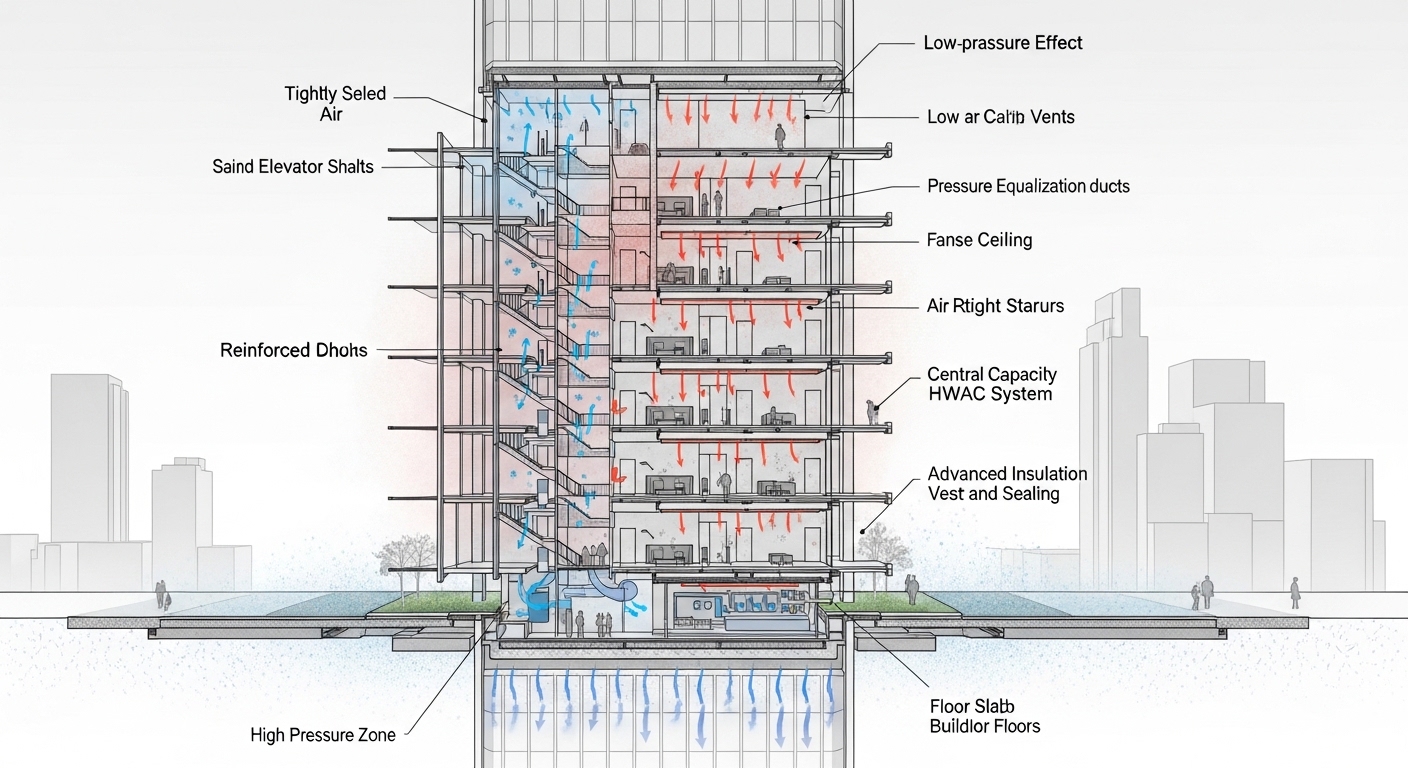
The Financial District is a vertical marvel. From the historic spires of Wall Street to the glass monoliths of the new World Trade Center complex, FiDi represents some of the highest-density residential and commercial living in the world. But for those living on the 60th floor of a luxury tower, the simple act of taking a high-pressure shower is actually a feat of complex engineering.
Gravity is the enemy of the skyscraper. In a standard five-story walk-up in the East Village, the city’s municipal water pressure is usually enough to get water to the top floor. In a FiDi high-rise, however, the weight of the water itself creates a massive logistical problem. Without sophisticated management, the resident on the 2nd floor would have enough pressure to blast through a steel plate, while the resident on the penthouse level would get nothing but a pathetic trickle.
Managing these extreme pressure differences is the silent “heartbeat” of building plumbing in Lower Manhattan.
The Physics of the Vertical Column
To understand why FiDi buildings need specialized systems, we have to look at how water behaves in a vertical pipe. Water is heavy. For every foot that water travels upward, it loses pressure due to gravity. Conversely, for every foot it drops, it gains pressure.
In a typical skyscraper, if you relied on a single pipe running from the basement to the roof, the pressure at the bottom of the building would be astronomical—potentially over 300 or 400 psi (pounds per square inch). For context, a standard home faucet is designed to handle about 50 to 80 psi. Without intervention, the pipes on the lower levels of a FiDi tower would literally burst, and fixtures would fail within days.
This is why “zoning” is the gold standard for downtown water conditions in our neighborhood’s tallest structures.
The Zone System: Breaking the Building into Pieces
A FiDi high-rise does not function as one giant plumbing unit. Instead, engineers divide the building into “pressure zones,” typically spanning 10 to 20 floors each. Each zone acts as its own independent ecosystem with its own dedicated hardware.
1. The Tank Method (Gravity-Fed) Many of the older, iconic towers in the Financial District still use the traditional gravity-tank method. Water is pumped from the city mains into massive tanks located on the roof or at intermediate mechanical floors. Gravity then pulls the water down to the apartments. To prevent the pressure from getting too high as the water falls, the building is “zoned” so that the tank only serves the 10 floors directly below it. If the building is 60 stories tall, there might be tanks on the 20th, 40th, and 60th floors.
2. The Booster Pump Method In many modern glass towers, you won’t see the classic wooden tanks on the roof. Instead, these buildings use sophisticated “Variable Frequency Drive” (VFD) booster pumps. These pumps sense the demand in the building in real-time. If three people on the 45th floor turn on their showers at once, the pumps ramp up instantly to maintain a steady flow. These systems are highly efficient but require constant maintenance to ensure the neighborhood reports of pressure loss remain at a minimum.
The Role of Pressure Reducing Valves (PRVs)
Even with zoning, the pressure within a single 15-floor block can vary significantly. This is where the Pressure Reducing Valve (PRV) becomes the unsung hero of FiDi living.
A PRV is a mechanical device installed at the point where the main “riser” pipe enters an individual apartment or a specific floor branch. It acts as a gatekeeper. If the water in the main pipe is screaming along at 120 psi, the PRV throttles it down to a comfortable, safe 65 psi before it ever reaches your designer kitchen faucet.
When a PRV fails—which they often do in the high-mineral environment of Manhattan—residents usually notice one of two things: a high-pitched whistling sound in the walls or a sudden, dramatic spike in water pressure that makes the pipes rattle. If you are hearing these “ghosts in the machines,” it’s often a sign that your floor’s pressure regulation is failing. You can find more about troubleshooting these sounds in our FAQ section.
Why Construction Impacts High-Rise Pressure
You might think that because a high-rise has its own pumps and tanks, it would be immune to the “brown water” or pressure drops caused by street-level work. Unfortunately, the opposite is often true.
When the city issues infrastructure alerts for Wall Street or Broad Street, they are often working on the massive trunk mains that feed the building’s “suction tanks” in the basement. If the city pressure drops, the building’s booster pumps have to work twice as hard to pull water into the system. If they pull too hard while the city is flushing the mains, they can suck in the sediment and air pockets discussed in our previous blog posts, distributing that debris through every floor of the tower simultaneously.
The Maintenance Challenge
Maintaining a vertical water system is an expensive, 24/7 job. The American Society of Plumbing Engineers (ASPE) sets rigorous standards for these systems, but the sheer scale of FiDi’s towers means there are thousands of potential points of failure.
- Seal Leaks: The high pressure on lower floors puts immense strain on gaskets and seals.
- Vibration: Pumps and high-velocity water create constant micro-vibrations that can loosen fittings over time.
- Backflow Prevention: Because these buildings “push” water so hard, they require complex backflow preventers to ensure that building water never accidentally pushes back into the city’s clean drinking supply.
What This Means for the Resident
If you live in a FiDi high-rise, your relationship with water is mediated by a multi-million dollar mechanical orchestra located in the basement and on the mechanical floors above you.
When you experience a loss of pressure, it is rarely a “city” problem; it is usually a “zone” problem. If your neighbor on the 10th floor has great pressure but you on the 12th floor have none, the issue is likely a localized pump or a PRV on your specific riser.
Understanding this hierarchy helps you communicate better with your building’s super or management company. Instead of saying “the water is out,” you can specify that it appears to be a pressure regulation issue on your specific zone—a distinction that can save hours of diagnostic time for the plumbing crew.
The Future of High-Rise Water
As buildings in Lower Manhattan continue to reach for the clouds, the technology is moving toward “smart” plumbing. We are seeing the introduction of AI-monitored leak detection systems that can sense a pressure drop of even 1 psi and shut off a zone before a leak causes millions in floor-to-floor damage.
The Financial District remains at the forefront of this vertical evolution. While the street-level infrastructure may be old, the systems inside our towers are some of the most advanced in the world.
If you have noticed a change in your apartment’s pressure after recent utility work in the area, feel free to reach out via our contact page. We track these fluctuations to help residents determine if the issue is a building-wide mechanical failure or a localized neighborhood event.