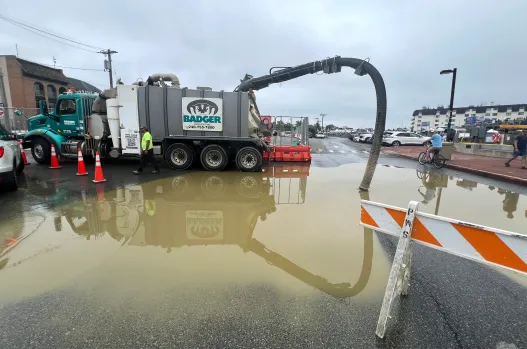
If you walk through the Seaport District, the Financial District, or the edge of Tribeca today, you are walking through a landscape of constant vertical growth. Towering cranes and sidewalk sheds have become as much a part of the scenery as the historic cobblestones. But while we often focus on the noise and the sidewalk diversions caused by these projects, there is a much quieter—and arguably more disruptive—process happening twenty feet below the pavement.
New construction in Downtown Manhattan is the primary driver of shifting water sediment patterns. For residents in established buildings, this often manifests as a sudden “puff” of brown water in the shower or a persistent gritty texture in the kitchen sink. Understanding the mechanics of how a new foundation on one block can ruin the water clarity on another is essential for navigating modern downtown water conditions.
The Subterranean Status Quo: A Century of Settling
To understand the disruption, we first have to understand the baseline. Much of the water infrastructure in Lower Manhattan consists of unlined cast-iron mains, some of which have been in place since the late 19th century. Over decades of steady, predictable flow, minerals like iron and manganese—naturally present in the city’s upstate supply—slowly settle at the bottom of these pipes.
In a neighborhood with no construction, this sediment remains largely undisturbed. It forms a stable, hardened layer of “scale” and silt. As long as the water pressure and direction remain constant, the water stays clear. However, the introduction of a new construction site acts like a massive “reset button” for these settled patterns.
The “Tap and Cut”: Re-Routing the Flow
Every new luxury tower or commercial hub requires a massive amount of water for both daily use and fire suppression systems. To get this water, construction crews must “tap” into the existing city mains.
When a new tap is made, the New York City Department of Environmental Protection (DEP) often has to shut off or “throttle” specific valves to isolate a section of the pipe. This redirection of water creates a sudden change in velocity. Water that was previously moving at a leisurely pace is suddenly forced through narrow bypasses at high speed. This “scouring” effect physically rips the settled sediment off the bottom of the old pipes and sends it downstream into the building plumbing of nearby residences.
Vibration: The Hidden Stirrer
It isn’t just the plumbing work that causes issues; it’s the sheer physical force of building in Manhattan. New construction often requires “pile driving” or deep rock excavation to reach the sturdy bedrock necessary to support a skyscraper.
The seismic vibrations from this heavy machinery travel through the soil and into the brittle, cast-iron water mains. These micro-shocks can loosen the “tuberculation” (rust mounds) inside the pipes. Even if there is no active water work happening on your block, a major excavation project two streets over can cause a slow, steady release of fine iron particulates into the local flow. You can see this correlation by checking our Neighborhood Reports, where “cloudy water” complaints often spike during the foundation-pouring phases of local projects.
Pressure Shifting and the “Vacuum” Effect
New buildings are incredibly thirsty. When a large-scale project begins testing its internal fire pumps or filling its massive rooftop tanks, it creates a temporary “draw” on the local grid. This sudden drop in pressure can create a vacuum effect in the surrounding smaller service lines.
This pressure fluctuation agitates the sediment pockets that have gathered in the “elbows” and “tees” of the street-level plumbing. For a resident in a neighboring five-story walk-up, this might result in “sputtering” faucets or a sudden burst of air and brown water as the system tries to re-balance itself. Keeping an eye on Infrastructure Alerts is the best way to anticipate these testing windows.
The Impact on Modern Filtration Systems
In Lower Manhattan, many residents have invested in high-end Point of Entry (POE) filtration systems to combat the inherent quirks of the aging grid. However, construction-related sediment is the natural enemy of these systems.
- Filter Blindness: A single “sediment surge” from a nearby water main tap can clog a five-micron sediment filter in minutes.
- Pressure Loss: As the filter fills with the fine silt kicked up by construction, the water pressure inside your apartment will drop. Residents often think the city has lowered the pressure, when in reality, their own filter is simply “blinded” by construction debris.
If you are experiencing a sudden loss of flow, it is worth consulting our FAQ to determine if it’s time to swap out your cartridges or perform a system flush.
Is This a Sign of Contamination?
The most common concern for residents is whether this construction-disrupted sediment is dangerous. According to the NYC Department of Environmental Protection, the discoloration is primarily iron and manganese. While unappealing, these are considered “secondary contaminants” by the Environmental Protection Agency (EPA)—meaning they affect the taste and color but are not generally a health risk.
However, the “grit” found in construction-heavy areas like Hudson Square or the Seaport can be abrasive. It can wear down the rubber seals in your faucets and stain laundry if it isn’t flushed out properly before running a cycle.
How to Protect Your Home During Local Construction
If you see a new site fence go up on your block, you should take proactive steps to manage your water quality:
- Monitor the “Morning Flush”: Construction work often happens late at night or early in the morning. Run your cold water for 2-3 minutes every morning to clear any sediment that settled in your building’s risers overnight.
- Clean Your Aerators: The tiny screens at the tip of your faucets are designed to catch debris. If your pressure feels low, unscrew them and rinse out the “pipe scale” that construction vibrations have likely loosened.
- Report the Patterns: Tracking when your water turns brown helps the community understand which projects are being “messy” with their utility taps. You can share your building’s experience via our Contact page.
The Long-Term “Silver Lining”
The disruption is frustrating, but there is a long-term benefit. As part of the permitting process for new Downtown towers, developers are often required to replace the aging water mains directly in front of their sites with modern, cement-lined ductile iron. These newer pipes do not rust or collect sediment in the same way the old cast iron does.
Over the next decade, as Downtown completes its current cycle of growth, the “patchwork” of new pipes will eventually create a cleaner, more stable grid. Until then, the “sediment shuffle” is simply a part of living in a neighborhood that is constantly reinventing itself.
For more deep dives into the subterranean world of Lower Manhattan, visit our full blog archive.